David Stybr: Engineer and Composer
It's Left Brain vs. Right Brain: best 2 falls out of 3
An Engineer's Approach to Music Appreciation
Chicago Area Mensa Regional Gathering: HalloweeM,
Saturday 25 October 2008, David Stybr, Guest Speaker
Back * Home * Next * Scores * E-mail to David Stybr
Program Description: Ever wonder how our diatonic scale originated? Ever wonder why the piano has white keys and a lesser number of black keys which stick up higher? Any good carpenter could fix this, but our guest speaker David Stybr will show that the pattern of our Do-Re-Mi scale is due to good old physics, mathematics and esthetics. Where do musical ideas originate, and how are they developed? Which musical forms are best suited to which themes, and provide the best balance? How does a composer decide upon the instrumentation or orchestration? As an engineer, Dave loves to figure out what makes things tick, from clocks to metronomes. Engineering is a far more practical career, but music remains a serious hobby. The past few years of amateur composition have taught him more about music appreciation than 4 decades of concerts and recordings, simply because he has tried the process for himself. Sonata form, rondo, fugue etc. make more sense than ever, and he would like to share some of his musical discoveries with you.
Introduction: the most basic component of music is the musical tones of the scale
Lecture: Edited Transcript
- Scales and Modes
- The Physics of the Scale * Table
- Modes
- C Ionian Mode: Modern Major
- A Aeolian Mode: Modern Minor
- F Lydian Mode
- G Mixolydian Mode
- Key Changes
- C Major
- D-Flat Major
- D Major
- E-Flat Major
- Alternate Scales
- Pentatonic: C# D# F# G# A# C# (Black Keys only)
- Whole-Tone: C D E F# G# A# C
- Chromatic or Twelve-Tone
- Tonal Ambiguity
- Atonal / Serial / Dodecaphonic
- Tone Row
- Precursor: First Ever Tone Row
- Tonal Chromaticism
- Microtones
- Compositions by David Stybr
- Transcriptions
- Original Compositions
- Classical Music SIG (Special Interest Group) of Mensa
- Name That Tune
- SIG Background, or "Bach-ground"
- Encore
- Question and Answer Period
Each year in late October, Chicago Area Mensa holds its Regional Gathering: HalloweeM. It is the largest Regional Gathering in American Mensa, and about 500 usually attend; only the national Annual Gathering attracts a larger crowd. On 25 October 2008 I presented a 1-hour lecture about An Engineer's Approach to Music Appreciation.
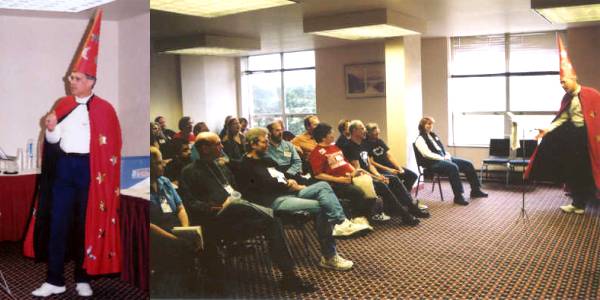
Dave in a wizard costume during his lecture at HalloweeM, as attendees guessed which musical work he represented: The Sorcerer's Apprentice by Paul Dukas.
Mensans are a curious lot who tend to question everything. Well, inquiring minds want to know. I love to figure out what makes things work, or why things are as they are, which destined me to be an engineer. Music was a strong passion, so when I decided upon a career, I pondered: "Engineering or music? Which pays a living salary?" Now music is a hobby, and I found the experts could tell me about what and how, but not much about why. One music book sparked my curiosity with this statement: "A musician learns to produce the required notes on his chosen instrument. A composer then tells him what notes to play." Well, how does the composer know the right notes?
For much of the next hour we will discuss the most basic component of music: the musical tones that form the scale. We'll also have some musical examples to show how these scales are used. Then, to get everyone out of this room as fast as possible, we will listen to some of my personal explorations of music, and a few of my own compositions. My aim as a composer is primarily for my own satisfaction and to understand the great masters. For example, the Finale of Mozart's "Jupiter" Symphony is one of the greatest displays of counterpoint of all time. I appreciate it all the more, simply because I have tried some counterpoint for myself. To conclude the hour, I'll briefly discuss the Classical Music SIG (Special Interest Group) of Mensa.
- Scales and Modes
- The Physics of the Scale
The diatonic scale has existed in Western music for more than 2½ millennia, so there must be a good reason for it. It's all a matter of physics, mathematics and esthetics. Nature produces a harmonic series of tones in which some tones are more important than others. For example, a string or a column of air vibrates not only as 1 unit (the tonic), but also more faintly as 2 halves (the tonic an octave higher), 3 thirds (the dominant a fifth higher), 4 quarters (the tonic another octave higher), 5 fifths (the mediant a major third higher), 6 sixths (the dominant a minor third higher) etc. The string thus vibrates not only as the primary tone but also as a series of overtones. These other tones can sometimes be heard as the fundamental vibrations decay. The fundamental is repeated as an overtone more than other notes, and certain intervals are more prominent than others. The harmonic series thus naturally gives musical sounds an underlying structure.
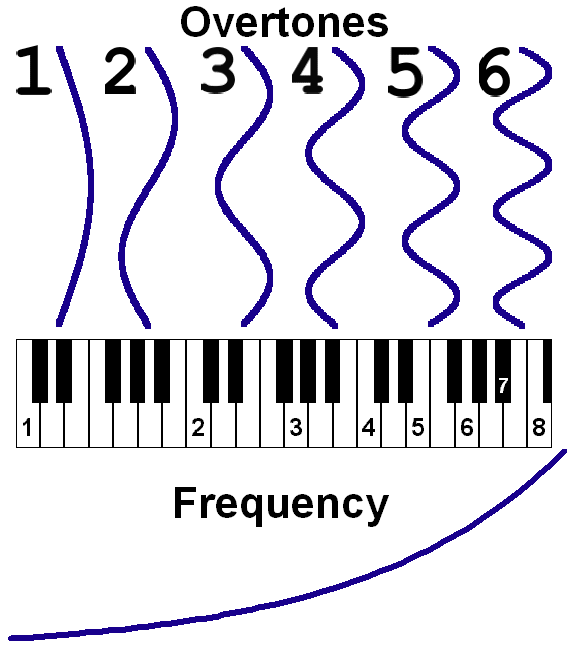 The ancient Greek mathematician Pythagoras, best known for his Pythagorean theorem of right triangles, first defined the diatonic scale. He defined a few basic intervals which then established all the other tones of the scale. Keyboard instruments were far in the future, but the piano helps to illustrate these intervals. The most fundamental interval is the octave, or 2 notes related in frequency by the ratio 2 : 1. The ratio of the perfect fifth (or G and C) is exactly 3 : 2, or 1-1/2 : 1. The perfect fourth (or F and C) was defined as 4 : 3, or 1-1/3 : 1. Several centuries later, Ptolemy redefined the perfect third (or E and C) as exactly 5 : 4, or 1-1/4 : 1. These intervals are extremely important, due to the simple-fraction nature of the ratios of their frequencies.
The ratios of these ratios then defined all the other notes of the scale. The interval between the third and the fourth was 1-1/16 : 1, or a half-step. The interval between the fourth and the fifth was 1-1/8 : 1, or a whole step. In sequence, 2 whole steps take us from C to D to E, a half-step from E to F, 3 whole steps from F to G to A to B, and a half-step from B to C. We can subdivide the whole steps into half-steps as well. Voilà! We have the white and black keys on a piano. This pattern of the diatonic scale emerges because the intervals are multiples, not sums; so the scale is exponential, not linear.
Table: The Physics of the Scale
|
| The Physics of the Scale: from Middle C |
Note |
Name |
Freq. |
Ratio |
Fraction |
| C |
Tonic |
261.626 |
1.000 |
1 |
| C# |
|
277.183 |
1.059 |
(12th Rt of 2) |
| D |
Supertonic |
293.665 |
1.122 |
1 1/8 = 1.125 |
| D# |
|
311.127 |
1.189 |
1 1/5 = 1.200 |
| E |
Mediant |
329.628 |
1.260 |
1 1/4 = 1.250 |
| F |
Subdominant |
349.228 |
1.335 |
1 1/3 = 1.333 |
| F# |
Tritone |
369.994 |
1.414 |
(Sq Rt of 2) |
| G |
Dominant |
391.995 |
1.498 |
1 1/2 = 1.500 |
| G# |
|
415.305 |
1.587 |
|
| A |
Submediant |
440.000 |
1.682 |
1 2/3 = 1.667 |
| A# |
|
466.164 |
1.782 |
1 3/4 = 1.750 |
| B |
Leading |
493.883 |
1.888 |
1 7/8 = 1.875 |
| C |
Tonic |
523.251 |
2.000 |
2 |
|
|
| The Physics of the Scale: continued |
Note |
Name |
Freq. |
Ratio |
Fraction |
| C |
Tonic |
523.251 |
2.000 |
2 |
| C# |
|
554.365 |
2.119 |
|
| D |
Supertonic |
587.330 |
2.245 |
2 1/4 = 2.250 |
| D# |
|
622.254 |
2.378 |
|
| E |
Mediant |
659.255 |
2.520 |
2 1/2 = 2.500 |
| F |
Subdominant |
698.456 |
2.670 |
2 2/3 = 2.667 |
| F# |
Tritone |
739.989 |
2.828 |
2 X (Sq Rt of 2) |
| G |
Dominant |
783.991 |
2.997 |
3 |
| G# |
|
830.609 |
3.175 |
|
| A |
Submediant |
880.000 |
3.364 |
|
| A# |
|
932.328 |
3.564 |
|
| B |
Leading |
987.767 |
3.775 |
|
| C |
Tonic |
1046.502 |
4.000 |
4 |
|
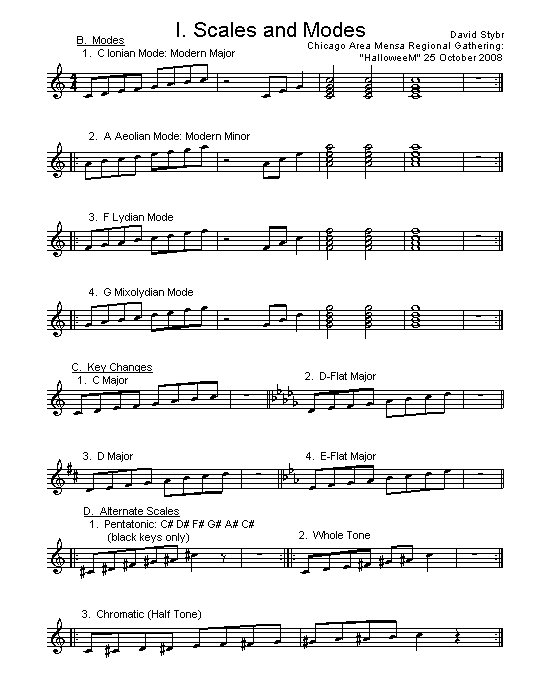
Okay, for those of you who are still awake, let's hear musical examples of some of the ancient and modern modes in which this scale is used, plus some alternate scales.
Examples: Scales and Modes
| |
|
|
|
| |
Examples: Scales and Modes
|
| |
|
|
|
- Modes
- C Ionian Mode: Modern Major
If we begin our scale on C, the result is the Ionian Mode defined by the ancient Greeks, which has become our modern Major Mode. A simple major triad chord sounds harmonious due to simple physics. In a major triad chord of C-E-G-C, the ratios of their frequencies are 1-1¼-1½-2. Beautiful, harmonious simplicity.
- Richard Strauss: Also sprach Zarathustra [Thus Spake Zarathustra]: Sunrise
This demonstrates the majesty of the basic interval: the fifth, C-G-C, with ratios of 1-1½-2.
- Johann Sebastian Bach: The Well-Tempered Clavier: Prélude in C Major
Unfortunately, Perfect Tuning works for only those key signatures with few sharps or flats, because the ratios between 2 adjacent notes are not constant. More distant keys sound terrible. Fortunately, Equal Temperament divides the scale into 12 equal half-steps separated mathematically by the 12th root of 2. The intervals are slightly mistuned (for example, the ratio of the fifth is 1.498 instead of 1½, and the third is 1.260 instead of 1¼), but the great advantage is that all keys are equally usable. True Equal Temperament became possible only in the early 20th Century with electronic frequency generators. Although it was not possible in his time, Johann Sebastian Bach promoted the concept. His Das Wohltemperierte Klavier [The Well-Tempered Clavier] consists of 2 Books of Préludes and Fugues in all 24 possible major and minor keys. His Prélude and Fugue in C Major from Book I immediately establishes the sonorities of the diatonic scale.
- A Aeolian Mode: Modern Minor
If we begin our scale on A instead of C, the result is the Aeolian Mode, which has become our modern minor mode.
- Edvard Grieg: Piano Concerto in A Minor: I. Allegro molto moderato (excerpt)
- F Lydian Mode
If we begin our scale on F instead of C, the result is the Lydian mode. This is like an F Major scale, but with B-Natural instead of B-Flat. This gives the music a powerful but unsettled character.
- Charles-Valentin Alkan: Douze Études dans les tons majeurs [Twelve Études in the Major Keys]: No. 5 in F Major: Allegro Barbaro (excerpt)
- G Mixolydian Mode
If we begin our scale on G instead of C, the result is the Mixolydian mode, like a G Major scale but with F-Natural instead of F-Sharp. This mode is sometimes used in church hymns, and it can give the music an attractive archaic quality.
- Ottorino Respighi: Concerto in Modo Misolidio [Concerto in Mixolydian Mode]: III. Passacaglia: Allegro energico (excerpt)
- Key Changes
The great advantage of equal tuning is that all keys are equally usable. Camille Saint-Saëns humorously demonstrated this in his Carnival of the Animals, with a pair of pianists among his ménagerie.
- Camille Saint-Saëns: Le Carnaval des Animaux [The Carnival of the Animals] : Pianistes
- C Major
- D-Flat Major (one more time!)
- D Major (let's hear that again, shall we?)
- E-Flat Major
- Alternate Scales
- Pentatonic: C# D# F# G# A# C# (Black Keys only)
The Pentatonic Scale can be regarded as only the black keys of the piano, or any other scale with identical intervals. This scale is commonly used in Oriental music, and Claude Debussy was quite fond of it. Debussy confounded most of the harmony professors because he broke most of the rules, but his ingenious music speaks for itself.
- Claude Debussy: Estampes: Pagodes (excerpt)
The December 1920 edition of La Revue musicale, which commemorated the recently-deceased composer, included a lengthy essay about Debussy's piano music by French pianist Alfred Cortot. He wrote that this piece is "might have no other ambition than that of awaking in us the idea of a site and architecture of the farthest Orient by slightly conventional employment of exotic sonorities and modulations."
- Claude Debussy: Préludes, Book I: La Fille aux Cheveux de Lin [The Girl with the Flaxen Hair]
Alfred Cortot wrote that this piece is "a tender paraphrase of the Scottish song of Leconte de Lisle, who tells the charm and sweetness of the distant beloved, 'seated in the flowering heather'."
- Whole-Tone: C D E F# G# A# C
Another subset of our diatonic scale is the Whole-Tone scale, made entirely of whole-steps. All notes being equal, this scale lacks a common tonal center and provides a fluid blurry character.
- Claude Debussy: L'Isle Joyeuse (excerpt)
- David Stybr: Brass Quintet in C Minor: IV. Finale: Allegro Molto (5:10)
This establishes a firm C Major tonality, then abruptly transitions to the Whole-Tone scale.
- Chromatic or Twelve-Tone
After the Whole-Tone scale of 6 whole-steps, it is a simple progression to the Chromatic or Twelve-Tone scale of 12 half-steps, which uses all notes on the keyboard. This is commonly associated with atonal or serial music, but chromaticism also greatly enhances tonal music.
- Tonal Ambiguity
- Ludwig van Beethoven: Symphony No. 9 in D Minor, "Choral": IV. Finale (excerpt)
Chromatic groping through tonal darkness leads to a radiant A Major tonality.
- Carl Nielsen: Symphony No. 4, "Det Uudslukkelige" ["The Inextinguishable"]: I. Allegro (excerpt)
"Musik er Liv, som dette uudslukkelig." ["Music is Life, and, like it, inextinguishable."]
Nielsen's music typically involves an evolution of tonalities. This is another example of chromatic groping through tonal darkness. However instead of a radiant resolution, the music erupts as E Major tries to wrest control away from the D Minor and C Major which began the symphony.
- Atonal / Serial / Dodecaphonic
- Tone Row: Alban Berg: Violin Concerto: I. Andante (beginning)
The Twelve-Tone scale is commonly associated with serial music, in which the 12 notes of the Chromatic scale are arranged into a tone-row or series, which becomes the basis for an entire piece. Theoretically the 12 tones of atonal music are related only to each other, not to any implied key. However this conflicts with the innate tonality of vibrating strings and winds. Alban Berg reconciled this tonal / atonal conflict more successfully than perhaps any other composer.
- Precursor: First Ever Tone Row: Franz Liszt: Eine Faust-Symphonie, I. Faust (excerpt)
Used as a chord progression within a tonal structure, rather than as a true tone row.
- Tonal Chromaticism
The Chromatic scale can also add brilliant colors to tonal music.
- Nikolai Rimsky-Korsakov: The Tale of Tsar Saltan: Flight of the Bumblebee
- Julius Fucík: Entrance of the Gladiators (excerpt) (Name That Tune!)
- Microtones
So far we've taken the standard scale, listened to 4 of its basic modes, then tried different subsets of the scale, from 5 notes to 12. And now for something completely different. What is unusual about this scale? I'll give you a hint. So far we've discussed music based on the diatonic scale, and our chromatic scale based on 12-note equal tuning.
- Easley Blackwood: Suite for Guitar in 15-Note Equal Tuning: IV. Gigue
Microtonal tuning divides the octave into more than 12 equal parts. Microtonal scales sound strange at first, and some are downright dissonant, but several are surprisingly sonorous and consonant. Some of these microtonal tunings, particularly 15-note and 19-note, have several simple-fraction intervals like our standard 12-note octave.
- Easley Blackwood: Fanfare in 19-Note Equal Tuning
In order to subdivide the scale even further, we must use electronic instruments. Composed in 1981 for the 30th anniversary of WFMT-FM in Chicago, this fanfare makes extensive use of the superior consonance of 19-note tuning major triads. It features a rapidly modulating succession of major keys which are clearly expressed.
That gives you a general idea of how I investigated the scale, which is perhaps the most important of the many facets of music. Now let's hear how some of this research has resulted in some of my personal explorations of music.
- Compositions by David Stybr
- Transcriptions
- J. S. Bach: Cantata No. 29: Sinfonia (transcribed for Steel Drum and Orchestra) (excerpt)
- George Frideric Händel: Solomon: Arrival of the Queen of Sheba (transcribed for Tuned Percussion Ensemble: Glockenspiel, Celesta, Music Box, Steel Drum, Xylophone, Marimba and Vibraphone) (3:30)
One of the most personal ways to study and explore music is to perform it. Another way is to make arrangements and transcriptions, which more or less involves taking scores apart and re-assembling them, not unlike engineering. This was primarily for my own satisfaction, and to explore how music works "from the inside."
- Original Compositions
- David Stybr: Life and Afterlife: Four Elegies for Soprano and Orchestra: II. Nocturnal Procession (6:00)
One musical friend who has made many brilliant and successful arrangements said that, try as he might, truly original ideas eluded him. On the other hand, he said that I seem to have a knack for independent ideas. Generally I destroy my own music after I have explored a specific facet or problem, but once in a great while something turns out to be worth saving. In this case, my self-imposed challenge was to gradually build up a piece of music from thematic and instrumental fragments.
- David Stybr: Theme and Variations in G Minor for Contrabassoon and Orchestra (17:45)
To my pleasant surprise, professional musicians began to enjoy my efforts, and to my greater surprise I received a few commissions. In this particular case, contrabassoonist Susan Nigro commissioned a concerto from me, which I cast in variation form. She performed the world première with New Philharmonic Orchestra conducted by Maestro Kirk Muspratt at College of DuPage, Glen Ellyn, Illinois in February 2005. I won't give up my day job as an engineer, but music will most likely become my 2nd career after I retire.
- Classical Music SIG (Special Interest Group) of Mensa
- Name That Tune
- I'm Always Chasing Rainbows, or
- Frédéric Chopin: Fantaisie-Impromptu in C-Sharp Minor
- SIG Background, or "Bach-ground"
In 1985 I founded the Classical Music SIG of American Mensa, and coordinated it until 1995. Unfortunately Mensa had no Classical Music SIG until I reactivated it in 2003. Apparently I'm the only person both crazy and hyperactive enough to be its Scheming Despot, I mean, Coordinator. To fulfill my diabolical diatonic plot for classical music world conquest (fiendish laugh), this year we officially became an international SIG in Mensa International. Our newsletter Maestro is distributed via e-mail as a PDF file, although some SIG members prefer printed copies. We also have a Yahoogroups discussion forum.
Classical music spans the centuries, and modern technology lets me shamelessly but legally plagiarize public domain musical articles from digitized archives around the world. As an amateur polyglot, I regularly reprint vintage French and German articles for our newsletter, plus my own English translations. Earlier this year we featured German composer Robert Schumann's lengthy 1835 analysis of French composer Hector Berlioz's Symphonie fantastique, plus an effusive letter from Berlioz to Schumann 2 years later. That Berlioz, what a screwball! It is a joy to read the composers' own words. If possible, I prefer to read the French or German originals, and translate them myself. Many standard English translations are merely paraphrases, or are independent articles which may bear little resemblance to the originals.
Of course British and American archives need no translation. A few months ago we featured fascinating 19th-Century accounts of composers who visited the United States, such as Johann Strauss Jr. in 1872 and Pyotr Ilyich Tchaikovsky in 1891, plus magazine articles written in the 1850s by American composer Louis Moreau Gottschalk while he lived in France. Our current newsletter features a lengthy article from The Scottish Review of January 1899 about visits to Scotland by composers Felix Mendelssohn, Ignaz Moscheles and Frédéric Chopin. I knew Mendelssohn loved Scotland, and I had heard about Moscheles, but I had no idea Chopin made his final concert tour in Scotland in 1848, the year before he died. A series of revolutions had erupted in continental Europe in 1848, and Chopin fled to the United Kingdom with a multitude of other musicians who lost their livelihoods for the duration. Chopin's visit was arranged by one Jane Stirling, a wealthy Scotswoman who was one of his pupils in Paris. She also tried to fill part of the gap after the breakup of his famous romance with George Sand.
Music is so educational. Last week I assisted my wife, author Denise Swanson, at one of her personal appearances to promote her book series. Another author brought a friend who happened to be visiting from . . . wait for it . . . Scotland! He was also a music lover, so we had a terrific conversation about . . . you guessed it . . . Mendelssohn, Moscheles and Chopin in Scotland. Thanks to this amazing coincidence, my newly-gleaned musical information made me seem far more knowledgeable about Scotland than I really was.
Music. Is there anything it can't do?
- Encore
- Johann Sebastian Bach / Ferruccio Busoni: Preludio, Fuga e Fuga figurata
Now let's return to Bach and Book I of his The Well-Tempered Clavier. Here is his Prélude and Fugue in D Major, BWV 850, in a wonderful transcription by Ferruccio Busoni which illustrates just how tightly integrated this music really is. Near the end of the Fugue, when it seems that this glorious music cannot possibly get any better, the magic increases. Busoni inserts his Fuga figurata, in which the Prélude and the Fugue are played simultaneously, with surprisingly lttle alteration. Far from a mere virtuoso stunt, Busoni presents the radiant music of Bach in a fresh perspective. Ladies and gentlemen, I take off my hat to the immortal mastery of Johann Sebastian Bach. One of the joys of fine music is that no matter how much I learn about it, countless wonderful discoveries remain.
Let me conclude with another engineering perspective. The 2 Voyager spacecraft which were launched in 1977 are now the farthest manmade objects in space. These spacecraft contain video and audio recordings as greetings to whatever intelligent life they might eventually encounter. Astronomer Carl Sagan asked biologist Lewis Thomas for his suggestions about music which would represent the human race at its very finest. Thomas replied: "I would send the complete works of Johann Sebastian Bach." Then he paused and added: "But that would be boasting."
- Question and Answer Period
- David Stybr: Andante Cantabile for String Orchestra (5:00)
- David Stybr: ContraBassooNova for Contrabassoon and Piano (3:00)
This piece was recorded by contrabassoonist Susan Nigro and pianist Mark Lindeblad, and will be released on a Crystal Records CD next year.
Back * Home * Next * Top * E-mail to David Stybr
© 2008 David Stybr * Updated 25 October 2008
This web site is purely for entertainment and information purposes.